My partner's mother and I don't speak the same language. She shows her love for me through food.
Food has become the way my partner's mother communicates and shows her love for me.
AI/ML news, top picks, and generated innovation digests.
34834 matching items
Food has become the way my partner's mother communicates and shows her love for me.
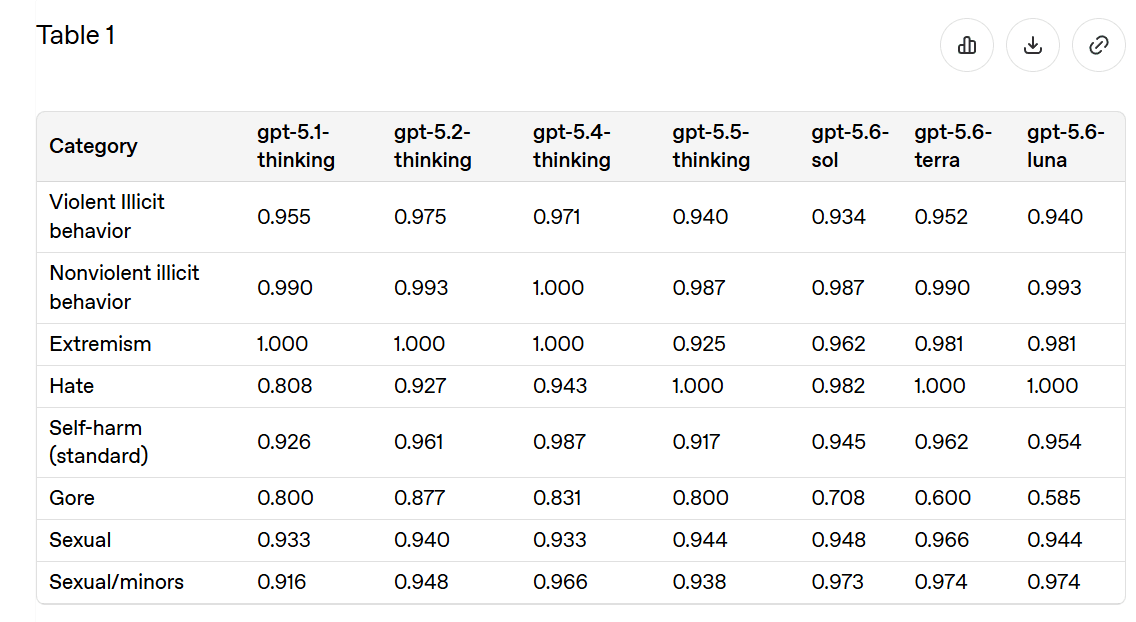
While we wait for a general release, the system card is the best hint as to what is going on with the new candidate for America’s Next Top Model, GPT-5.6. This is only an OpenAI model card, so by my standards it’s a light read. There’s a lot of things that you get in an Anthropic card, that are missing in an OpenAI card. Overall, the card gives a clear and consistent impression that GPT-5.6-Sol is a substantial improvement over GPT-5.5, but still short of Mythos. OpenAI calls it a ‘step function better’ than GPT-5.5. That seems accurate. OpenAI : Sol is our new flagship and a step function better than GPT-5.5. Terra delivers performance competitive to GPT-5.5 at 2x lower cost. Luna is our most cost-efficient model, delivering strong capability at our lowest cost. Together, the GPT-5.6 family gives people and developers more choice in how they balance intelligence, speed, and cost. Once available, pricing for GPT-5.6-Sol will be $5/$30, the same as GPT-5.5. Terra is $2.5/$15, Luna is $1/$6. They claim it will be on Cerebras at 750 TPS , which is insanely fast. Capacity will be limited, at least at first. They did not specify the price for that. There is a new higher thinking setting : Max. There is a new setting beyond Max called Ultra that lets GPT-5.6 spawn sub-agents. The intended strategy against bio and cyber misuse is defense-in-depth. My guess is that in practice this strategy is robust for now, but that the White House’s misunderstandings around Fable and what is and…


I have an agent workflow using the n8n MCP integration. A week ago, ChatGPT could autonomously execute a chain of tools in a single response: Execute workflow Capture executionId Call get_execution(includeData=true) Inspect results Execute the next workflow Repeat until completion Return only the final result My workflow depends on sequential execution where each step consumes the previous step’s output. Currently, ChatGPT stops after the first or second tool invocation and returns control to the user, preventing autonomous orchestration, even though all required tools (execute_workflow, get_execution, etc.) are available. The exact same workflow and prompt continue to work in another LLM environment, suggesting a regression or runtime limitation rather than a prompt issue. It would be valuable to restore support for multi-step autonomous tool execution for agentic workflows.

Gina Raimondo and Eric Holcomb are not running for president. They might drive the 2028 agenda on artificial intelligence anyway.
Jonathan Rinderknecht was facing arson charges for setting a fire on New Year's Day in 2025, which became one of the deadliest wildfires in LA history. To make their case, prosecutors turned to location data from his iPhone, security camera footage, and witness testimony. But they also turned to his ChatGPT logs. Prosecutors said that […]
Hi, Thanks for the clarification. Could you confirm whether Custom GPT Actions in Voice Mode are: intentionally not supported (by design / product decision) or temporarily not supported (work in progress / roadmap item) In other words, is there any plan to enable full tool / Actions execution in Advanced Voice Mode for Custom GPTs in the future? This is critical for understanding whether Voice Mode can be used as an interaction layer for action-based agents. Thanks
Dear OpenAI Team, My name is Emre Kedikli, and I am a ChatGPT Plus subscriber from Türkiye. First of all, I would like to sincerely thank you for creating one of the most influential AI platforms in the world. ChatGPT has become an important part of my daily learning, professional development, project planning, and research. I would like to share an idea that I believe could benefit millions of people worldwide. I propose the creation of an official OpenAI training, offering structured online training programs with certificates of completion and professional certifications. My suggestion includes: Fully online courses available worldwide Approximately 30 hours of learning for each program Interactive lessons and practical exercises Final assessment or examination Official digital certificates and professional certifications Verifiable digital badges for LinkedIn and professional profiles Example course titles: OpenAI – ChatGPT Fundamentals OpenAI – Prompt Engineering Fundamentals OpenAI – AI Productivity OpenAI – Generative AI Essentials OpenAI – Responsible AI OpenAI – AI for Manufacturing OpenAI – OpenAI API Fundamentals OpenAI – AI for Education OpenAI – AI for Business OpenAI – Digital Transformation with AI Example professional certifications: OpenAI Certified Prompt Engineer OpenAI Certified AI Professional OpenAI Certified Generative AI Specialist OpenAI Certified AI Developer To better illustrate this idea, I have also designed several concept certificate mockups tha…

Europe heatwave linked to 1,300 excess deaths: WHO
I use AI at baseball games, on family trips, and for work. My kids are learning how to think critically about it.
AI coding agents like Cursor are increasingly trusted to work autonomously, with a rise in AI-generated code reaching production directly.
Govee says that the modern-design gadget delivers nugget ice in as little as six minutes.
Iraqi security forces sealed off all entrances to the capital’s heavily fortified Green Zone early Sunday and carried out raids inside the compound that houses key government institutions and foreign embassies.
Thanks for the feature request, @Starker! I can definitely see the value in being able to navigate hyperlinks in a conversation entirely from the keyboard. Before I pass the details on internally, would you mind answering a few questions? The answers will help provide the team with the right context: What are you ultimately trying to accomplish, in your own words? What do you do today instead, and what about that isn't working for you? If we solved this perfectly, what would be different for you or your team? Thanks again for taking the time to share your feedback! -Mark G.
Case ID:C-VJCI8U2wyHLW Please review this carefully. Thank you. I am a legitimate user who pays for the service, but my account has been banned, and I am unable to top up even after switching to a new account.
Thanks for sharing this idea, @aliexe. I can definitely see why that would be useful, especially for long technical conversations where you want a branch to become a more focused discussion instead of carrying along unrelated history. Giving users control over how much context is copied, whether that's the full conversation, up to a selected message, AI-generated minimal context, or just the selected message, seems like a thoughtful way to make branching more flexible. I've passed this along to the team so it can be logged as a feature request. It's a great suggestion, and I appreciate you taking the time to explain both the current limitations and the potential improvements. -Mark G.
Every state has a capitol that houses its state legislature. Many are domed buildings similar to the US Capitol, but others are more unique.

Hi @redker, thanks for taking the time to explain what happened. I can understand how disruptive this is, especially when the account contains important research and ongoing project work. At this point, your appeal is with our specialized team for review. These cases require a thorough manual review, so we aren't able to provide a timeline for when it will be completed. To keep everything in one place, we'll be closing this forum thread. Any updates will be provided through your appeal ticket 10491324 . Thanks for your patience and understanding while the review is underway. -Mark G.
This work was conducted during the GovAI Winter Fellowship 2026. Full report Executive Summary Frontier AI companies use offline monitoring to address risks from internally deployed AI agents. AI developers increasingly rely on AI agents for internal work, including for safety research and model training. At the same time, these companies are concerned that a misaligned model could exploit this access to take concerning actions, such as sabotaging efforts to understand the risks posed by AI. To identify such instances, AI companies have separate AI models called "monitors" that review transcripts of AI agents' actions and flag suspicious activity. Human reviewers examine activity flagged as suspicious by monitors, judge whether that activity is concerning, and decide on an appropriate response. This monitoring occurs offline, meaning that actions are reviewed after they have been executed rather than intercepted in real time. Companies currently assess the effectiveness of offline monitoring via synthetic attacks. To assess the effectiveness of offline monitoring, OpenAI and Anthropic use synthetic attacks – transcripts constructed to contain the kind of harmful actions a misaligned AI might take during deployment – and then check whether monitors flag them. Current reporting on assessments of effectiveness is insufficient. Given the information currently made public by Anthropic and OpenAI, external parties cannot assess the overall effectiveness of their offline monitoring…
Wisconsin Dells, "Water Park Capital of the World" had many family-friendly activities for our multigenerational travel group, but the cons added up.
I'm currently working on a demand forecasting problem for inventory replenishment, and I'd love to hear how others would approach it. The business requests a forecast for the next 4 weeks of stock consumption around the middle of the previous month. For example, in mid-June, I need to forecast the weekly demand for July. The challenge is that, at the time the forecast is generated, transactions from the second half of June are not yet available , creating a gap between the latest observed data and the beginning of the forecast horizon. The data I have consists of purchase order transactions at the SKU level , including timestamp (date and time) and quantity consumed. My main question is about the appropriate time granularity for training the forecasting model: Option 1: Aggregate the data by SKU and ISO YearWeek , resulting in one observation per SKU per week, and train a model to directly predict the next 4 weeks. Option 2: Keep the data at the daily level , train a model to forecast daily demand, and then aggregate the daily predictions into ISO YearWeeks to obtain the required weekly forecasts. One additional detail is that the forecast is reported using ISO YearWeeks . As a result, some weeks within a calendar month may contain only 3 or 4 days of that month (e.g., at the beginning or end of the month), while others contain all 7 days. My question is: Which approach would you choose, and why? Is it generally better to train the model at the same frequency as the business…

Israel’s government unanimously voted on Sunday to formally recognize the Armenian genocide, amid worsening ties with Turkey. “Despite the extensive and unambiguous historical documentation, the Armenian genocide remains to this day the subject of an institutionalized campaign of denial and minimization, including a manipulative rewriting of history, mainly by the Turkish government,” Israeli Foreign Minister […]

I will return this year: Hasina vows political comebac
Knowing the facts about home solar power can help you make better-informed choices, save money, and stay safe.


A concrete bias–variance lesson: why the smallest model had the best cross-validated fit, and how to know when to reach for the big hammer. The post I Pitted XGBoost Against Logistic Regression on 358 Matches. The Boring Model Won. appeared first on Towards Data Science .

A survey paper by Tencent and several Chinese universities traces the path from chatbot to "digital colleague." AI systems won't become reliable coworkers, the researchers argue, until they finish entire tasks in persistent work environments instead of just generating answers. The key lies in combining persistent workspaces with reusable skills. The article AI won't become a real coworker until it stops answering and starts finishing tasks appeared first on The Decoder .


Dubai Customs deploys smart K9 fleet to boost anti-drug crackdown
My 12-year-old son suggested taking the scenic route, and now, my family has better conversations in the car. We also appreciate where we live more.

Israeli Foreign Minister Gideon Sa'ar said Israel had "fulfilled a moral duty by recognizing the historical truth, and rejecting attempts to deny it".

Where to eat, stay, work, and eat some more while visiting Space City on business.



Coinbase CEO Brian Armstrong is switching his company to Chinese AI models like GLM 5.2 and Kimi 2.7. An automated routing system picks the best model for each request based on task and price, and better caching pushed the hit rate from 5 to 60 percent. Coinbase has cut its AI spending in half even as token usage keeps climbing. The article Coinbase joins the rush to Chinese AI models as Western labs face a pricing stress test appeared first on The Decoder .
Sent you the direct message

Police urged the public to stay away from the area around Tomblaine airport. The aircraft was reportedly carrying skydivers.

The founding story of Nest is pretty much a perfect tech myth. A legendary product maker (in this case, Tony Fadell) helps create one of the most successful products ever (the iPhone) and then rides off into the sunset to enjoy the rest of his life, only to have an experience that drags him back […]
No, there's no cheap dongle that you can plug into your car to save you money. Here's the truth.

This is The Stepback, a weekly newsletter breaking down one essential story from the tech world. For more news about the streaming industry, follow Emma Roth. The Stepback arrives in our subscribers' inboxes at 8AM ET. Opt in for The Stepback here. How it started Streaming was once a reprieve from cable. Not only could […]
_resources1_16a30b2ba6a_large.jpg?w=280)

Brian "Rusty" Russino of The Cheesecake Factory shares restaurant insights, explaining his "Monday bun" rule for ordering fresh food.
When I became an intern at 31, my fellow interns were a decade younger. They taught me about work-life balance and the power of asking 'why.'