AI/ML News & Innovations Hub

AI/ML news, top picks, and generated innovation digests.

★ Visit ai-karthik.com
422Sources
37394News Items
8Top Picks
221Blogs
successLast Run

Latest AI/ML News

37394 matching items

LatAm Journalism Review AI 2025-06-27 00:11 UTC Score 26.0 AI-176-20250627-regional-ai--268354d2 Full article

Google’s AI search features slash traffic to news sites, deepening sustainability crisis

"Google’s rollout of tools like AI Overviews and AI Mode—chatbots that answer users’ search queries—has begun shifting online behavior from browsing links to reading AI-generated responses, drastically reducing traffic to news sites. The resulting drop in organic traffic is forcing many media organizations to rethink their sustainability models in an ecosystem increasingly dominated by tech […] The post Google’s AI search features slash traffic to news sites, deepening sustainability crisis appeared first on LatAm Journalism Review by the Knight Center .

Cross Validated 2025-06-18 13:43 UTC Score 12.0 AI-113-20250618-social-media-1241d5c8

What statistical test should I use to assess the influence of core maintainer count on quarterly PR abandonment rates?

I'm analyzing open-source software development data and trying to determine whether the number of core maintainers per quarter influences the PR abandonment rate (specifically, contributor-abandoned pull requests) across several projects. Here's what my data looks like: For each quarter of the year (e.g., Q1, Q2, Q3, Q4), per project: core_maintainers: Number of core maintainers, identified using a refined commit-based heuristic (developers contributing ≥5% of total commits). abandonment_rate: Ratio of contributor-abandoned PRs to total PRs in that quarter. Goal: I want to test whether the number of core maintainers significantly affects the PR abandonment rate per quarter.

Time series patient visits for XGBoost classifier
AI Stack Exchange 2025-06-18 07:47 UTC Score 12.0 AI-110-20250618-social-media-da9752d8 Full article

Time series patient visits for XGBoost classifier

I’m developing a tree-based model classifier (XGBoost) using some healthcare (patient visits) data. The data has a time dimension, and I want to observe if there is a longitudinal effect for the prediction of the target feature. To predict the target for the current visit (Timepoint n), it should incorporate information from the previous visit(s) (T0 to T(N-1)). The input shape is visit_time, features, and target/label. Let’s say, I have a patient with 5 visits (T1 – T5). The idea is that the first prediction (T1) will be just based on the features for this timepoint. To predict T2, I want to add information from T1. Then, for T3, it will be T1 + T2, and so on, T5 (T1+ T2 + T3 + T4). The number of timepoints (visits) vary for each patient. I read that I can add lags and rolling windows. But still couldn’t figure out the best way to do it. Any thoughts on what and how to do it for my scenario?

Synced 2025-06-16 07:39 UTC Score 28.0 AI-041-20250616-ai-specialis-5050dce9 Full article

Researchers from PSU and Duke introduce “Multi-Agent Systems Automated Failure Attribution

"Automated failure attribution" is a crucial component in the development lifecycle of Multi-Agent systems. It has the potential to transform the challenge of identifying "what went wrong and who is to blame" from a perplexing mystery into a quantifiable and analyzable problem The post Researchers from PSU and Duke introduce “Multi-Agent Systems Automated Failure Attribution first appeared on Synced .

EleutherAI Blog 2025-06-12 00:00 UTC Score 27.0 USR-0184-20250612-research-aca-0a6d62bc Full article

Studying inductive biases of random networks via local volumes

In this post, we will study inductive biases of the parameter-function map of random neural networks using star domain volume estimates. This builds on the ideas introduced in Estimating the Probability of Sampling a Trained Neural Network at Random and Neural Redshift: Random Networks are not Random Functions (henceforth NRS). Inductive biases To understand generalization in deep neural networks, we must understand inductive biases. Given a fixed architecture, some tasks will be easily learnable, while others can take an exponentially long time to learn (see here and here).

GitHub Engineering 2025-06-10 16:00 UTC Score 31.0 USR-0062-20250610-ai-specialis-464b5215 Full article

How GitHub engineers tackle platform problems

Our best practices for quickly identifying, resolving, and preventing issues at scale. The post How GitHub engineers tackle platform problems appeared first on The GitHub Blog .

EleutherAI Blog 2025-06-05 20:00 UTC Score 33.0 USR-0184-20250605-research-aca-9f1209c2 Full article

The Common Pile v0.1

Announcing the Common Pile v0.1: An 8TB Dataset of Public Domain and Openly Licensed Text

Are repeated measures models applicable when only the exposure is repeatedly measured and the outcome only once?
Cross Validated 2025-06-05 06:48 UTC Score 20.0 AI-113-20250605-social-media-8f6fce53 Full article

Are repeated measures models applicable when only the exposure is repeatedly measured and the outcome only once?

In many resources, I see that repeated measures analyses—such as mixed-effects models or GEE—are commonly applied when the outcome is measured multiple times within the same individuals. However, I was wondering: Can these models also be used when it’s the exposure that is repeatedly measured (e.g. at several time points), and the outcome is measured only once (e.g. at a later time point)? For example, suppose I measure maternal blood pressure at 3 time points during pregnancy (repeated exposure), and I want to study its association with birthweight (a single outcome). Can I use a mixed-effects model or GEE to account for within-subject correlation in the exposures? I’m curious which modeling approaches are most appropriate in this context, and if there are any recommended papers or examples. So for example in R Studio: model

AGI Is Not Multimodal
The Gradient 2025-06-04 14:00 UTC Score 25.0 AI-037-20250604-ai-specialis-6895a2b0 Full article

AGI Is Not Multimodal

"In projecting language back as the model for thought, we lose sight of the tacit embodied understanding that undergirds our intelligence." –Terry Winograd The recent successes of generative AI models have convinced some that AGI is imminent. While these models appear to capture the essence of human

Stanford HELM 2025-06-04 00:00 UTC Score 32.0 USR-0025-20250604-research-aca-0450ed55 Full article

Reliable and Efficient Amortized Model-Based Evaluation

TLDR: We enhance the reliability and efficiency of language model evaluation by introducing IRT-based adaptive testing, which has been integrated into the HELM framework.

AI Now Institute 2025-06-03 01:42 UTC Score 27.0 USR-0135-20250603-ai-specialis-24081bb3 Full article

Artificial Power: 2025 Landscape Report

Our latest annual report maps the current state of play with the AI market, interrogates the industry’s key sources of power, and provides an actionable strategy to reclaim public agency over the future of AI. The post Artificial Power: 2025 Landscape Report appeared first on AI Now Institute .

Deep Learning Indaba 2025-06-02 17:53 UTC Score 32.0 USR-0189-20250602-research-aca-345a60d2 Full article

Letter to the Community: Prof. AZA Allsop

This month’s letter is presented by Professor AZA Allsop: artist, neuroscientist, and psychiatrist who conducts research at the intersection of social cognition, music mindfulness, and psychedelics. AZA’s intersectional research is motivated by the desire to decode methods for treating mental suffering and enhancing the evolution of society at large. I am honored to have this […] The post Letter to the Community: Prof. AZA Allsop appeared first on Deep Learning Indaba .

EleutherAI Blog 2025-05-30 22:00 UTC Score 20.0 USR-0184-20250530-research-aca-51280b23 Full article

Product Key Memory Sparse Coders

Using Product Key Memories to encode sparse coder features

Block Engineering Blog 2025-05-28 16:00 UTC Score 22.0 USR-0060-20250528-ai-specialis-7cdfea5e Full article

Revamping Data Science Interviews

Interviews are not just about improving hiring outcomes - they are about strengthening the entire DS function

Synced 2025-05-28 09:31 UTC Score 29.0 AI-041-20250528-ai-specialis-ba3765b3 Full article

Adobe Research Unlocking Long-Term Memory in Video World Models with State-Space Models

By combining State-Space Models (SSMs) for efficient long-range dependency modeling with dense local attention for coherence, and using training strategies like diffusion forcing and frame local attention, researchers from Adobe Research successfully overcome the long-standing challenge of long-term memory in video generation. The post Adobe Research Unlocking Long-Term Memory in Video World Models with State-Space Models first appeared on Synced .

EU AI Act Tracker / Explainer 2025-05-23 13:35 UTC Score 33.0 AI-010-20250523-glossary-def-44f8b813 Full article

AI Literacy Programs in Europe – Supporting Article 4 of the EU AI Act

As organisations across Europe navigate the implementation of the EU AI Act — including Article 4, which addresses the importance of AI literacy — there is growing interest in accessible and practical training resources. This document presents a non-exhaustive selection of AI literacy programs that may be useful for companies, institutions, and professionals seeking to better understand […]

Synced 2025-05-15 17:58 UTC Score 36.0 AI-041-20250515-ai-specialis-9f81d633 Full article

DeepSeek-V3 New Paper is coming! Unveiling the Secrets of Low-Cost Large Model Training through Hardware-Aware Co-design

A newly released 14-page technical paper from the team behind DeepSeek-V3, with DeepSeek CEO Wenfeng Liang as a co-author, sheds light on the “Scaling Challenges and Reflections on Hardware for AI Architectures.” The post DeepSeek-V3 New Paper is coming! Unveiling the Secrets of Low-Cost Large Model Training through Hardware-Aware Co-design first appeared on Synced .

Data Science Stack Exchange 2025-05-10 09:13 UTC Score 21.0 AI-111-20250510-social-media-e900e520

Loss while fine tuning a transformer based pose estimation model not reducing

I am trying to fine-tune a transformer/encoder based pose estimation model available here at: https://huggingface.co/docs/transformers/en/model_doc/vitpose When passing "labels" attribute to the forward pass of the model, the model returns "Training not enabled". The core logic I have implemented is as follows. Since the model outputs heatmaps, I use a post-processing pipeline to get back the keypoint predictions in the image space, and compute a MSE Loss between these reconstructed keypoint (using soft argmax) and ground truth keypoints. Is this a correct way of thinking? Comparing heatmap to heatmap might seem more intuitive, but I didn't want to write the keypoint to heatmap and add the specific image processor's normalization with the worry that they might go off-scale Things I have tried: modified the model's heatmap head to predict for 24 keypoints for dogs instead of the 17 for humans it was trained on 2.added a Simple Adapter network right after the layer norm and before the model's heatmap head unfreeze some of the backbone layer's gradually track loss with both normalized and unnormalized keypoints. Added gradient clipping. the post processing pipeline is a differentiable approxiamtion of https://github.com/huggingface/transformers/blob/main/src/transformers/models/vitpose/image_processing_vitpose.py Tuning LRs However, gradient flow through the head and the adapter and the deeper encoder layers have been very very small. here is the notebook link: https://github.c…

AI Expo Africa 2025-05-08 06:08 UTC Score 33.0 USR-0194-20250508-regional-new-f0c35143 Full article

Dubai joins South Africa AI Association initiative to launch global AI trade & investment hub

The hub will serve as a catalyst for collaboration and platform for startups in high-potential, emerging markets. Dubai – Dubai Future Foundation (DFF), through the Dubai Centre for Artificial Intelligence (DCAI), has partnered with the South African Artificial Intelligence Association (SAAIA) to help launch a dedicated AI trade & investment hub with the aim of fast-tracking […]

On the Biology of a Large Language Model (Part 2)
Yannic Kilcher 2025-05-03 16:16 UTC Score 32.0 AI-140-20250503-podcasts-and-d3110d17 Full article

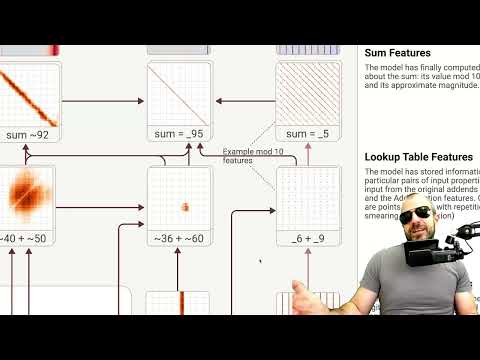
On the Biology of a Large Language Model (Part 2)

An in-depth look at Anthropic's Transformer Circuit Blog Post Part 1 here: https://youtu.be/mU3g2YPKlsA Discord here: https;//ykilcher.com/discord https://transformer-circuits.pub/2025/attribution-graphs/biology.html Abstract: We investigate the internal mechanisms used by Claude 3.5 Haiku — Anthropic's lightweight production model — in a variety of contexts, using our circuit tracing methodology. Authors: Jack Lindsey†, Wes Gurnee*, Emmanuel Ameisen*, Brian Chen*, Adam Pearce*, Nicholas L. Turner*, Craig Citro*, David Abrahams, Shan Carter, Basil Hosmer, Jonathan Marcus, Michael Sklar, Adly Templeton, Trenton Bricken, Callum McDougall◊, Hoagy Cunningham, Thomas Henighan, Adam Jermyn, Andy Jones, Andrew Persic, Zhenyi Qi, T. Ben Thompson, Sam Zimmerman, Kelley Rivoire, Thomas Conerly, Chris Olah, Joshua Batson*‡ Links: Homepage: https://ykilcher.com Merch: https://ykilcher.com/merch YouTube: https://www.youtube.com/c/yannickilcher Twitter: https://twitter.com/ykilcher Discord: https://ykilcher.com/discord LinkedIn: https://www.linkedin.com/in/ykilcher If you want to support me, the best thing to do is to share out the content :) If you want to support me financially (completely optional and voluntary, but a lot of people have asked for this): SubscribeStar: https://www.subscribestar.com/yannickilcher Patreon: https://www.patreon.com/yannickilcher Bitcoin (BTC): bc1q49lsw3q325tr58ygf8sudx2dqfguclvngvy2cq Ethereum (ETH): 0x7ad3513E3B8f66799f507Aa7874b1B0eBC7F85e2 Litecoin (LTC…

EU AI Act Tracker / Explainer 2025-05-02 14:29 UTC Score 30.0 AI-010-20250502-glossary-def-11783c58 Full article

AI Regulatory Sandbox Approaches: EU Member State Overview

AI regulatory sandboxes are an important part of the implementation of the EU AI Act. According to Article 57 of the AI Act, each Member State must establish at least one AI regulatory sandbox at the national level by 2 August 2026. This post provides an overview of how different EU Member States are approaching […]

AI Snake Oil 2025-05-01 11:47 UTC Score 20.0 USR-0106-20250501-ai-specialis-ac25e786 Full article

AGI is not a milestone

There is no capability threshold that will lead to sudden impacts

Lilian Weng Blog 2025-05-01 00:00 UTC Score 33.0 USR-0112-20250501-ai-specialis-d1eab7b9 Full article

Why We Think

Special thanks to John Schulman for a lot of super valuable feedback and direct edits on this post. Test time compute ( Graves et al. 2016 , Ling, et al. 2017 , Cobbe et al. 2021 ) and Chain-of-thought (CoT) ( Wei et al. 2022 , Nye et al. 2021 ), have led to significant improvements in model performance, while raising many research questions. This post aims to review recent developments in how to effectively use test-time compute (i.e. “thinking time”) and why it helps.

Synced 2025-04-30 15:46 UTC Score 39.0 AI-041-20250430-ai-specialis-98e41d3a Full article

DeepSeek Unveils DeepSeek-Prover-V2: Advancing Neural Theorem Proving with Recursive Proof Search and a New Benchmark

DeepSeek AI releases DeepSeek-Prover-V2, an open-source LLM for Lean 4 theorem proving. It uses recursive proof search with DeepSeek-V3 for training data and reinforcement learning, achieving top results on MiniF2F. The post DeepSeek Unveils DeepSeek-Prover-V2: Advancing Neural Theorem Proving with Recursive Proof Search and a New Benchmark first appeared on Synced .

AI Stack Exchange 2025-04-30 15:32 UTC Score 21.0 AI-110-20250430-social-media-70e0b924 Full article

What is the complete formula to get LLM VRAM usage?

I would like to find the GPU size required to run an hypothetical LLM, considering all possible factors, like: P: Model parameters (total or MoE active parameters) Q: Quantization bits C: Context length cap (from what I understand, the context can be capped to allow a sort of smaller "batch-size" limit) ATT: Type of attention used (Full attention, Flash attention...) Other I understand how the usual formula I can find around Space = ((P × 4Bytes) / (32 / Q)) × overhead does describe some part of the picture, but does not give the full idea down to the details.

Deep Learning Indaba 2025-04-30 08:58 UTC Score 28.0 USR-0189-20250430-research-aca-935c19dd Full article

Throwing bones

With a good enough model, could we throw the bones and predict the impact of the Deep Learning Indaba on ourselves, and on the continent? Rarely, with the benefit of hindsight, there is a moment that stands out as wildly impactful. For me, attending the Deep Learning Indaba (DLI) in 2022 was one of those […] The post Throwing bones appeared first on Deep Learning Indaba .

EU AI Act Tracker / Explainer 2025-04-25 15:17 UTC Score 33.0 AI-010-20250425-glossary-def-4d3a8388 Full article

Providers of General-Purpose AI Models — What We Know About Who Will Qualify

This content is outdated – Draft guidelines have now been published by the AI Office, which you can learn more about here. On 22 April 2025, the AI Office published preliminary guidelines clarifying the scope of the obligations for providers of GPAI models. These outline seven topics that are expected to be covered in the […]