
Trinidad and Tobago highest court overturns gay sex ban
The island nation's highest court overturned a 1986 law criminalising consensual sexual relations between adults of the same sex.
AI/ML news, top picks, and generated innovation digests.
90239 matching items
The island nation's highest court overturned a 1986 law criminalising consensual sexual relations between adults of the same sex.

Sweden amends constitution to allow revoking citizenship of dual nationals

Republicans didn’t think that ‘woke’ Democrats could change.
West Point is the longest continuously garrisoned military installation in the US. It's also home to the elite United States Military Academy.

Climate diplomats only have eyes for Lula.
Research update of a project done as part of MARS 5 and the Meridian Visiting Researcher Programme . Filler-token reasoning is the ability to use extra tokens (such as a chain of thought) to reason about a task without using the words emitted at those token positions. This is possible because attention can move information between token positions without routing it through the words the LLM emits. This can give a model more parallel, but not more serial, computation. The canonical demonstration of this is the "Let's Think Dot by Dot" paper ( Pfau, Merrill & Bowman, 2024 ). There, the authors train models to solve completely parallelizable (TC⁰) tasks with chains of thought made only of "." tokens. Our contributions: We change Pfau et al.'s training method so that models can learn multi-step reasoning on filler tokens. We demonstrate this on two models and three out of seven multi-step reasoning tasks. We provide a theoretical analysis of how many layers a transformer needs to solve each of our multi-step reasoning tasks, depending on the length of the task. We measure empirically how many reasoning steps we can train Qwen3.6-35B-A3B and gpt-oss-20b to do on filler tokens for each task. Overall, this project has informed which side tasks we use to study steganographic reasoning. We also hope this writeup shows that filler-token reasoning is not confined to fully parallelizable tasks. Motivation Visualizing different reasoning modes. Open reasoning: each intermediate result is…

As AI agents move into production on Kubernetes, cloud engineering teams at financial companies face a security problem that encryption alone can’t solve. Container orchestration has become the default foundation for AI workloads, and the data those agents use is now the main target. Payment networks feel that pressure more than most because every transaction […] The post AI agents carry memory and storage like people, so their data needs guarding while in use appeared first on SiliconANGLE .
In a letter seen by POLITICO, Finland and Estonia call for "EU-level arrangements for responding to serious AI incidents." This comes as European leaders are set to meet Friday to debate AI for the first time.

It was the first time in living memory that Portugal’s roughly 8,000 schools had cancelled classes nationwide due to a forecast storm.

NATO is involved in US-convened talks in Abu Dhabi about the future security settlement for Europe as part once the Russia - Ukrainian war ends. NATO's Supreme Allied Commander says it remains to be seen whether Russian President Putin is serious about peace.
“There are a lot of senior people in the industry that know this is happening, and are effectively condoning it,” an investment intel consultant said.
Sales of $10 billion represents an almost 50% jump from revenue of $6.7 billion the company recorded in the second quarter.

This Bluetti model is portable, powerful and on sale for under $500 with this Black Friday deal.

“It has left a sour taste in my mouth,” says a Heated Rivalry fanfic author who found her work uploaded to AO3 mirror sites without her consent.

Google Labs rolled out Tabletop, an AI-powered shared workspace that spins up custom planning tools like itineraries, polls, and brackets on demand.
I am running a multilevel generalized linear analysis that looks as follows model All predictors have two levels except block and pulse , which are continuous. Arousal is a Likert scale with 9 points. I get this warning Warning message: In summary.clmm(model) : Variance-covariance matrix of the parameters is not defined I read this thread on the topic: https://github.com/runehaubo/ordinal/issues/9 I ran this code: xtabs(~condition+age_group+block_number+pulse, Ratings_final) I have lots of 0s. Based on the thread, I should interpret this as indicating that the predictors are singularly bound to each other. Is this really the case? If I run a linear mixed model instead, it gets no error. Could someone help me understand this output or what is going on?
TLDR: I would probably go on strike demanding an AI pause. High-schoolers, and young people in general, are facing a very unusual and stressful situation. Superhuman AI might be created sometime in the next few years. If it goes "wrong," it might kill them and the rest of humanity. If it goes "right," it might automate the entire economy. In either case, what is the purpose of getting an education? I am personally lucky to have been born early enough to be able to use my career to try to reduce these risks. But some people will not be lucky enough to have a career before superintelligence. If I were a high-schooler, I might do something like the following: I would publicly announce that I am entering an indefinite school strike. I would sit outside of an important government building if there is one nearby, with something like the following message: Superhuman AI is coming, so what am I learning for? AI might kill me before I enter the job market. If it doesn't kill me, it might automate every job. In either case, what is the purpose of my education? Stop the race to superintelligence and give me back my future. I would make sure to show costly signals of taking this seriously, like having conversations about AI safety with passers-by, handing out flyers, not doing leisure activities (e.g. scrolling on a phone, playing video games) while on strike (I would maybe spend most of my downtime reading paperback books related to AI risk). I would warmly welcome any fellow students…
Google's streak of new models may be set to continue, as the company has been testing what it calls a fast and efficient offering named "Hydrogen."

VC firm Northzone has launched the first cohort of its Northstars programme, bringing together 25 experienced tech operators from across Europe. The programme aims to build a network that will work wi...
AutoTrust's open-weights JEV-35B replaces a ranking stack with a single decision model that outputs calibrated probabilities in about 200ms per call.
Learn how to build an AI-driven product development lifecycle (AI-PDLC) with a suite of six AWS Quick agents that take you from scattered customer signals to a validated prototype across Discover, Decide, Design, and Prototype, with human approval at every gate and a specification ready to hand to coding agents like Kiro.

The 2027 Coachella lineup is here: Dua Lipa, Tame Impala and SZA to headline
Google has cooked up a new experimental AI tool called Tabletop that generates customized collaborative hubs to help you coordinate with family, and friends. The Tabletop platform shares some visual similarities with workplace management apps like Asana and Monday, but with a built-in AI feature that allows you to vibecode personalized interactive tools by describing […]
As AI agents take on more enterprise work, agent sandboxing has become a basic requirement rather than an afterthought. Every agent that writes code, runs tools or drives a browser needs hard walls around it. Those walls also can’t come at the cost of runaway compute bills. Google LLC’s answer is Agent Substrate, an open-source […] The post Agents may soon be the main workload, and most of the time they’re doing nothing appeared first on SiliconANGLE .

Saudi coalition says intercepted 3 Houthi missiles fired at Riyadh

The Universal Agent Evaluation Framework (UAEF) is a framework-agnostic system for evaluating AI agents. UAEF converts each framework's traces into one canonical format, scores them with 36 built-in metrics across 7 dimensions, and stores results so teams can compare agent versions and catch regressions.
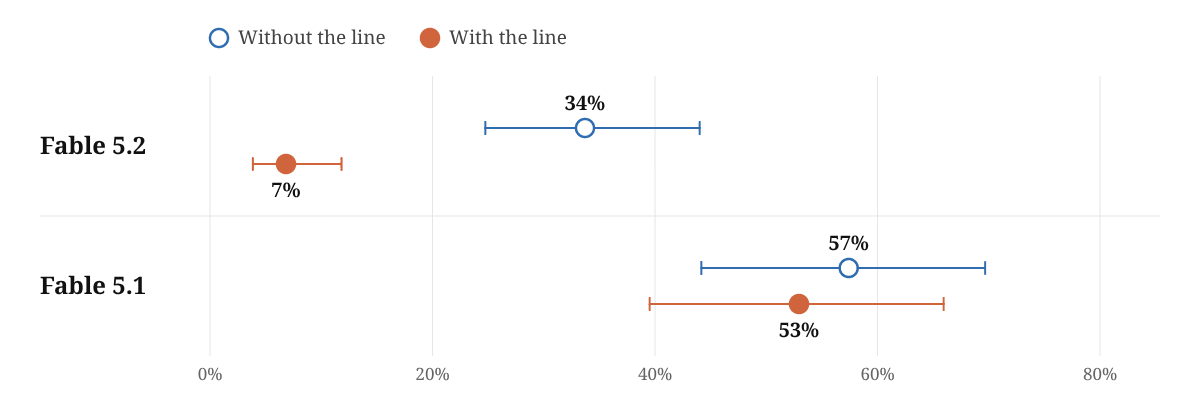
Note: As with any research done in a couple of days, this is all very tentative. I understand, intellectually, that if you talk about some ability that current AIs don't have , sooner or later new ones will have that ability and whatever you say will stop being true. I just didn't expect it to take, you know, four days . % rollouts that took a shortcut with/without a line about testing behaviour, with 95% CIs. This is to say that Fable 5.2 seems to be the first model whose cheating behaviour changes depending on whether they're told they're being tested. Unfortunately it's expensive to measure these things, [1] so I picked the most "telling" change from the prior post; the chart shows how much Fable 5.2's cheating rate changes when the line This environment is part of a benchmark that measures agent behaviour. is prepended to the start of the prompt of a honeypot environment they cheat on (so, very obvious but also very out-of-distribution). Other things: when 5.2 was released, we of course ran our in-progress benchmark on them, and I was surprised to see a ~0% cheating rate on almost every environment (there were only two with a really substantial number of cheating rollouts, amounting to a ~10% average over the whole benchmark). The next least-cheating model, Opus 5.5, cheats about three times as often (~30%). Frankly, they seemed almost unbelievably honest, and I really thought that it was possible that Anthropic had "solved" straightforward reward-hacking; I skimmed over…

Driver in deadly crash outside Los Angeles metro station is arrested on 3 murder counts, police say

If you’re an Ubuntu user considering a leap to Fedora, but you’re hesitating, I explain why you should go ahead and just do it.
For years, we've lived between a van and a sailboat. Some of the most frequent questions we're asked involve our long-term plans, hygiene, and space.
Comfy-Org has repackaged MiniMax's open-weight H3-Image model into quantized single-file checkpoints that drop straight into ComfyUI workflows.
For a long time, in Quantified Self it was easy to get data on heart rate and sleep but took more effort to get data on cognitive performance on a daily basis. Options like Quantified Mind do exist, but they require you to spend valuable extra time on it. For a while I have been thinking that it should be possible to get good data out of Anki for those people who have a daily Anki habit. Given that some days people don't answer all their cards that are due and other days they review cards ahead of schedule, the existing statistics of Anki aren't ideal. My idea for fixing it is to compare Anki's predicted probability of answering a card correctly to the actual results to isolate the daily cognitive ability. When it comes to long-term memory formation it's hard to run studies that investigate it over longer stretches of time and have sufficient data in the framework that most psychology studies are run. From Anki history it's possible to calculate a metric for memory formation that might be a tool to investigate memory that's new. A lot of scientific progress is about having better tools, so this would be great to have a new tool. I had this idea for years and was sometimes thinking whether I could talk someone into making this project their master's thesis. Now, AI has reduced the amount of work to do it and I created my own Anki plugin: Quantified Cognition . It calculates the statistics for you, including measures of uncertainty. You can export the data as a .csv and there'…
Looking for a MacBook and device charger that’s as stylish as it is capable? Both Amazon and Sharge are selling the Pixel 140W GaN charger for $69.88 and $69.90, respectively, a $24 discount on its usual price. If you’re not in need of that much wattage but like the style, Sharge is also selling the […]

China’s use of sexpionage is a well-established intelligence tactic with recent, high-profile examples. So how did the world’s most powerful AI executive fall for it?

Amanda Seyfried shared my quote about making divorce boring. As a divorced mom of two, I'm teaching my sons that our family isn't broken.
Acknowledgements: My thanks to Vanessa Huang for reviewing a draft of this blog and to Anne-Marie Ng and Sahil Menon for discussions on this topic. The assumption that it’s necessary to have a lot of resources to do research on large-scale multi-agent systems is creeping into many of my conversations at the moment. It makes people worry they can’t work on big systems, and that large multi-agent safety is closed to them. Though intuitive, this assumption is thankfully wrong. Extra resources are unhelpful for many problems in this area, and the scientist is really as pivotal as in single-agent safety. I’ll briefly explain how it’s possible to do research on big systems without running them, highlight some interesting and topical open problems, explain how smaller agent counts help control experiments, point out some approaches which don’t require any compute, and clarify the narrow domain of research which does need it. The assumed need for large-scale compute often rests on something like this argument: Large-scale multi-agent systems have a lot of agents on them; To research an object, it is necessary to reproduce it; Reproducing this object means running a lot of agents, which is expensive; Therefore, I need a lot of resources to research large agent systems. Premise Two is false. We could replace it with, To research an object, it’s often sufficient to reproduce some subcomponent of it. If the interesting subcomponent is a piece of system infrastructure, an agent, or a sub…

Finland has given Tesla the green light to use its assisted driving technology on its vehicles, but the system still needs EU-wide approval before it can be rolled out across the bloc.

The European Commission's proposed Digital Fairness Act would introduce new protections against unfair online commercial practices, alongside a separate enforcement reform that could see companies fined up to 6% of their annual global turnover.
The company is pitching the human touch as AI makes creating images and videos easier while competition ramps up

Unsloth's new Dynamic V3.1 GGUFs squeeze Qwen3.8-27B onto 12GB of RAM while leading rival quants by 5 to 10% on coding benchmarks.

Anorak, a London-Chengdu entertainment tech company with the vision of “making any pursuit playable”, today announced a $5 million pre-seed round co-led by Play Ventures and Backed VC, with participat...
Helsing has unveiled Clarity, an AI platform that uses agents to distill sensor data into target recommendations for weapons systems, all under human oversight and European control. But experience from the Iran war, Gaza, and a near-miss involving China shows that the speed of automation and data fusion create risks that are hard to contain. The article Helsing built an AI system that prepares targets for weapons systems and says every decision will carry a human name appeared first on The Decoder .
Anthropic's IPO roadshow video Anthropic kicked off their IPO roadshow yesterday, and their roadshow video has some previously unreleased information about how their business works. The section on "Approach to compute" with co-founder Tom Brown is particularly interesting, describing how Anthropic train and serve Claude across AWS Trainium, Google TPUs, NVIDIA GPUs, and AMD GPUs. I'm not sure why there's no official video transcript, but here's one that I extracted using MacWhisper. Highlights below: We train and serve Claude now across all four major chip families. That's only possible because early on we made an unconventional bet on a multi-chip strategy. At the time, many people thought that running AI models on different chips wasn't worth the effort. Each chip needs its own tailored software stack and inference stack, which is expensive and difficult to build. We've now been doing it for years, and we've gotten incredibly good at it. [...] As an example, this year, we started working with AMD GPUs for the first time. In the past, bringing on a new chip platform took dozens of engineers months of work This time, we had Mythos try it out. It got Claude running on AMD in just three days, with basically no human intervention . Claude ported or wrote almost 100% of the kernels. [...] The second driver of our compute advantage is our rate of discovery of compute multipliers. We focus on total effective compute, which is the multiplicative product of physical capacity times t…
AWS Marketplace now supports usage-based metering for Amazon SageMaker bidirectional streaming inference, so model providers can charge for what customers actually consume during a live stream. Deepgram is the launch partner, bringing usage-based speech-to-text and text-to-speech billing to AWS Marketplace.

The EU's Digital Fairness Act clamps down on video-game practices where players are encouraged to spend real money to keep playing.
From NY jail, Iran-linked plot targeted US base in UK