Leveraging Linux Internals to Supercharge Osquery Malware Detection
Using /proc to find fileless malware
AI/ML news, top picks, and generated innovation digests.
27534 matching items
Using /proc to find fileless malware
It is known that multitask objectives in neural networks sometimes have the effect of improving the performance of the neural network for each of the tasks individually (versus training the same network for each task individually). To what extent is this true when fine tuning a pretrained, single-task neural network to deal with a multi-task objectives versus training from scratch?
[ Hacker News discussion , LinkedIn discussion , Twitter thread ] Update (Feb 2026) : The full list of open source AI repos is hosted at Good AI List , updated daily. It’s balooned to 15K repos, and you can submit missing repos. You can also find some of them on my cool-llm-repos list on GitHub. Four years ago, I did an analysis of the open source ML ecosystem . Since then, the landscape has changed, so I revisited the topic. This time, I focused exclusively on the stack around foundation models. Data I searched GitHub using the keywords gpt , llm , and generative ai . If AI feels so overwhelming right now, it’s because it is. There are 118K results for gpt alone. To make my life easier, I limited my search to the repos with at least 500 stars. There were 590 results for llm , 531 for gpt , and 38 for generative ai . I also occasionally checked GitHub trending and social media for new repos. After MANY hours, I found 896 repos. Of these, 51 are tutorials (e.g. dair-ai/Prompt-Engineering-Guide ) and aggregated lists (e.g. f/awesome-chatgpt-prompts ). While these tutorials and lists are helpful, I’m more interested in software. I still include them in the final list, but the analysis is done with the 845 software repositories. It was a painful but rewarding process. It gave me a much better understanding of what people are working on, how incredibly collaborative the open source community is, and just how much China’s open source ecosystem diverges from the Western one. The Ne…
Despite the challenges faced by the media industry, the Haitian Times –a print and digital newspaper catering to Haitian immigrants in the United States– has managed to not only survive but thrive by adapting to the changing needs of its audience. Through a combination of smart financial decisions, leveraging technology like AI, and deeply understanding […] The post The Haitian Times thrives by understanding its audience, making smart financial decisions and embracing AI appeared first on LatAm Journalism Review by the Knight Center .
Despite the challenges faced by the media industry, the Haitian Times –a print and digital newspaper catering to Haitian immigrants in the United States– has managed to not only survive but thrive by adapting to the changing needs of its audience. Through a combination of smart financial decisions, leveraging technology like AI, and deeply understanding […] The post The Haitian Times thrives by understanding its audience, making smart financial decisions and embracing AI appeared first on LatAm Journalism Review by the Knight Center .

Exploring the utility of large language models in autonomous driving: Can they be trusted for self-driving cars, and what are the key challenges?
I am currently studying "Understanding Machine Learning from Theory to Practice" written by Shai Shalev-Shwartz and Shai Ben-David. I want to understand how i can use the Definitions and Results of the Theory he describes in Practice. Consider the problem of fitting a one dimensional polynomial to data; namely, our goal is to learn a function, $h : R → R$ , and as prior knowledge we consider the hypothesis class of polynomials up to degree 10. Our class $H$ has VCdim( $H$ )=11 so with the fundamental theorem of statistical learning it is APAC learnable with ERM. If i fix my $\epsilon,\delta \in (0,1)$ , then if my sample size is equal to $ C_2\frac{11+\log(1/\delta)}{\epsilon^2}$ i can be sure that with probability of atleast $1-\delta$ , ERM will output a hypothesis with \begin{equation} L_D(h_s)\leq \min_{h}L_D(h)+\epsilon. \end{equation} $C_2$ is a constant and $h_S$ is the hypotheis of the ERM algorithm. Now in practical Terms, this doesnt tell me anything about the quality of my Model. Because we dont know the underlying Distribution $D$ we can't compute $L_D(h)$ for any $h\in H$ . But i can compute $L_S(h)$ for every $h\in H$ in particular $L_S(h_S)$ . My intuition is then that we could use the uniform-convergence property of our class $H$ (VCdim(H) is finite) to get a bound for how much $L_D(h_S)-L_S(h_S)$ differ. With probability of atleast $1-\delta$ \begin{equation} L_D(h_S)\leq \min_{h}L_D(h)+\epsilon \leq \min_{h}{L_S(h)+\epsilon}+\epsilon=L_S(h_S)+2\epsilon \end…
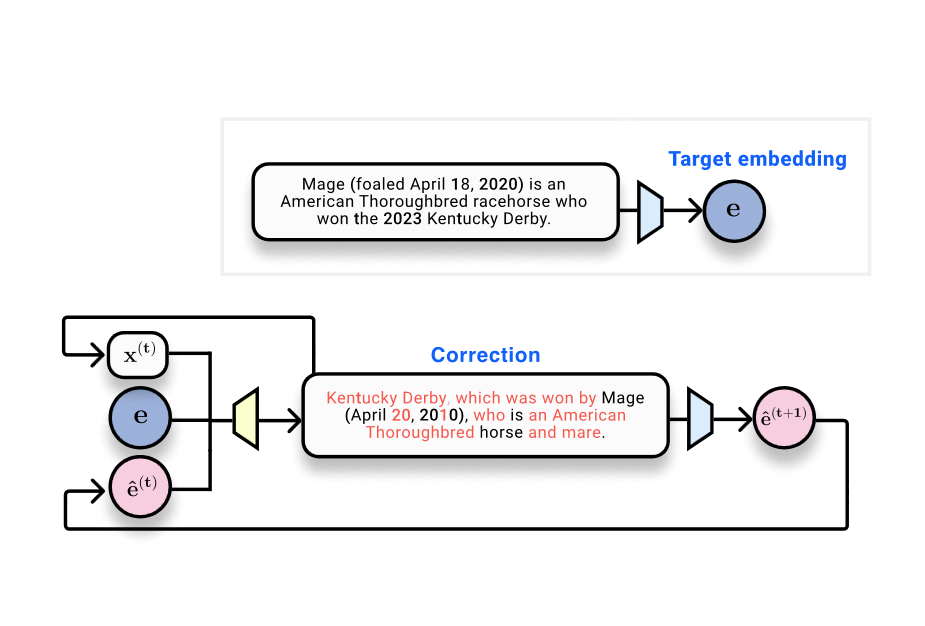
'Vec2text' can serve as a solution for accurately reverting embeddings back into text, thus highlighting the urgent need for revisiting security protocols around embedded data.
I am trying to quantify the effect of financial sanctions on cross-border capital flows. I have built a dyadic dataset of sanctions and capital flows by country pair and year. My sample period spans 20 years. I conducted a fixed effects regression where the explanatory variable for sanctions is a dummy variable that takes the value 1 in each year in which a sanction is imposed between a given country pair. I include fixed effects for each country pair and each year in the sample. \begin{equation*} \text{Capital_flows}_{c_1, c_2, t} = \beta_0 + \beta_1 \text{sanction}_{c_1, c_2, t} + \eta_{c_1, c_2} + \varphi_t + \varepsilon_{c_1, c_2, t} \end{equation*} (where $\eta_{c_1, c_2}$ is a set of country-combination specific fixed effects and $\varphi_{t}$ is a set of time-specific fixed effects.) As I understand, my fixed effects will remove all the time-invariant factors determining capital flows that were previously included in my error term. As such, I am now stuck with the various time-variant factors determining capital flows. Having done some reading, the main problem with my approach seems to be endogeneity, i.e., my sanctions dummy will be correlated with my error term. I was planning on addressing this issue by carefully adding additional (time-variant) control variables to my model. However, having spoken to one of my professors, he mentioned that the way to resolve this is through an instrumental variable approach and a Generalised Method of Moments estimator. I have se…

When should one not use normalization between layers like Batch Norm, Layer Norm, Instance Norm, and Group Norm in deep learning while training a DL model?
A challenge of building AI applications is choosing which model to use. What if we don’t have to? What if we can predict the best model for any prompt? Predictive human preference aims to predict which model users might prefer for a specific query. Human preference has emerged to be both the Northstar and a powerful tool for AI model development. Human preference guides post-training techniques including RLHF and DPO . Human preference is also used to rank AI models, as used by LMSYS’s Chatbot Arena . Chatbot Arena aims to determine which model is generally preferred. I wanted to see if it’s possible to predict which model is preferred for each query . One use case of predictive human preference is model routing. For example, if we know in advance that for a prompt, users will prefer Claude Instant’s response over GPT-4, and Claude Instant is cheaper/faster than GPT-4, we can route this prompt to Claude Instant. Model routing has the potential to increase response quality while reducing costs and latency. Another use case of predictive human preference is interpretability. Mapping out a model’s performance on different prompts can help us understand this model’s strengths and weaknesses. See section Experiment results for examples. Here’s what predictive human preference for different model pairs looks like for the prompt “ What’s the best way to cluster text embeddings? ”. The predictions were generated by my toy preference predictor. The bright yellow color for the (GPT-4,…
Investing in reliability and test engineering
I am reading The Elements of Statistical Learning: Data Mining, Inference, and Prediction by Trevor Hastie, Robert Tibshirani, Jerome Friedman, and I don’t understand the meaning of "factor" in the following paragraph: Qualitative variables are typically represented numerically by codes. The easiest case is when there are only two classes or categories, such as “success” or “failure,” “survived” or “died.” These are often represented by a single binary digit or bit as 0 or 1, or else by −1 and 1. For reasons that will become apparent, such numeric codes are sometimes referred to as targets. When there are more than two categories, several alternatives are available. The most useful and commonly used coding is via dummy variables. Here a K-level qualitative variable is represented by a vector of K binary variables or bits, only one of which is “on” at a time. Although more compact coding schemes are possible, dummy variables are symmetric in the levels of the factor . Also I want to know what mathematics knowledge I should have to understand this book and if it’s deprecated or not.
I am reading The elements of statistical learning : data mining, inference, and prediction / Trevor Hastie, Robert Tibshirani, Jerome Friedman and I don´t understand the meaning of "factor" in the following paragraph: Qualitative variables are typically represented numerically by codes. The easiest case is when there are only two classes or categories, such as “suc- cess” or “failure,” “survived” or “died.” These are often represented by a single binary digit or bit as 0 or 1, or else by −1 and 1. For reasons that will become apparent, such numeric codes are sometimes referred to as targets. When there are more than two categories, several alternatives are available. The most useful and commonly used coding is via dummy variables. Here a K-level qualitative variable is represented by a vector of K binary variables or bits, only one of which is “on” at a time. Although more compact coding schemes are possible, dummy variables are symmetric in the levels of the factor . Also I want to know what math´s knowledge I should have to understand this book and if it´s deprecated or not.

Have you ever trained a model you thought was good, but then it failed miserably when applied to real world data? If so, you’re in good company.
I have read (*) that a common technique to attack a black box AI system based on a neural network is to use it to train a surrogate model to make the same classifications as the black box one. Once this is done, one can look for adversarial examples on the surrogate model (on which the attacker has access to all the weights and can compute gradients). The key property that makes such attacks successful is transferability : an adversarial example on the surrogate model is likely to be an adversarial example on the black box model. Question: Do we know why such transferability properties hold and under which conditions? (*) Although I don't remember where I first read it, this is mentioned in the book Not with a bug but with a sticker although it doesn't get into technical details (this is a book for the general public).
I am having a ML based production application, using flask, deployed on GCP server using gunicorn workers. In each incoming request, a text sentence is received. It is using sentence transformers (All-MiniLM-L6-v2 model), which is loaded globally one time, to create embeddings of the incoming text and then use pre trained kmeans (also loaded globally) to predict/map it to a intent cluster. Basically, goal is to find intent of the sentence. I have ample resources and the requests are also constant in number and texts are also similar, but still each day the CPU load is gradually increasing. Avg response time on 1st day was around 200 ms average, after 10 days now it is 400 ms. I have tried deleting the embedding variable using 'del' command in the code itself, also forcing python garbage collector using 'gc.collect()' in a thread which executes after the main process execution is completed, but still the issue is coming. One thing I have noticed is that if I dont use del and gc.collect(), the RAM starts to go down gradually. With both these, RAM is constant but now CPU usage is gradually going up day by day, hence the load and response time. I have spent weeks on this issue trying to debug it but have got no solution, any help would be appreciated.
I'm studying Variational Autoencoders and a lot of the literature says that the posterior is intractable because the marginal distribution p(x) is intractable since the space of z is so large we cannot possibly integrate over it all. So to avoid this they create a lower bound on the log likelihood, the ELBO, which they then try to maximize. The term for the ELBO is: $$E_q[log~ p(z,x)]-E_q[log~q(z)]$$ What I am trying to understand is how is this now tractable. The expectations in the ELBO are still over the distribution of q. Take the first term for example: $$E_q[log~ p(z,x)]=\int_{}^{}q(z)~log~p(z,x)dz$$ Is this not still an integral over all z values? How did we make this problem any more tractable by finding the ELBO? Additional Question: Also another thing I was confused about is we always say the posterior p(z|x) is not computable because we don't have p(x), but how exactly do we have the numerator, p(x,z). $$p(z|x)=\frac{p(x,z)}{p(x)}$$ Is this because we assume a prior, and then also assume that we can model p(x|z) with a decoder?
Effective developer tools
The best reason I have seen for using variational autoencoders is when dealing with sparse data. The Gaussian noise "splats" out the input distribution (see this StackExchange answer ). However, normalizing flows do the same thing, without the loss of information a VAE incurs. It feels as if VAEs are used only because everyone else is using them, and then a bunch of StackExchange posts reinforce the message that VAEs are the way to go , when they're theoretically suboptimal. I understand that normalizing flows are a little slower (at either training or inference), and more difficult to implement, but is there a theoretical reason that makes VAEs a legitimate choice?

I have seen a few Kaggle notebooks that list without reason that RFE works better when removing correlated variables. I struggle to see the reason why so I conducted some of my own research and would like to verify if my conclusions are correct. From my research with sklearn's CART algorithm, I have taken a good predictive feature (Feature A) and a highly correlated feature with some extra noise (Feature B). It seems that due to high correlation, their mean impurity decrease is very similar and the splits roughly split the feature importance between the two variables. This creates situations where Feature A and Feature B can be ranked highly if Feature A is a good predictor despite Feature B being redundant. Feature B will likely not be removed for several iterations and reduce the model score for these first few iterations, thereby limiting the combination of features that RFE considers. But I presume there are multiple factors that influence the way we identify a "highly correlated variable". At which correlation cutoff point do we determine that the variables will hurt the RFE feature selection process? For example, the number of splits in the algorithm will be one determining factor. If Feature A only has a single split, then Feature B will not benefit from having high correlation with Feature A, and likely be removed by RFE without problems.
Update June 2024: Anyscale Endpoints (Anyscale's LLM API Offering) and Private Endpoints (self-hosted LLMs) are now available as part of the Anyscale Platform. Click [here](https://console.anyscale.com/?utm_source=anyscale&utm_medium=blog&utm_campaign=blog_callout&utm_content=june2024_product_update_subheading) to get started on the Anyscale platform.
I am new to statistics and linear regression and I came across the face that auguste bravais discovered regression line but didn't realize it. Auguste Bravais (1811-1863), professor of astronomy and physics, is probably best known for his work in crystallography (Nelson, 1998). With respect to error theory, he is best known for a paper he wrote in 1846 titled "Analyse mathématique sur les probabilités des erreurs de situation d'un point" [translated: "Mathematical analysis on the probability of errors of a point"]. This work is renowned for being the very first mathematical exposition of the theory of correlation. Pearson (1896), later to recall these remarks, said that it was Bravais who first discussed the fundamental theorems of the correlational calculus. In his famous paper of 1846, Bravais, mathematically, not empirically, found the equation of the normal surface for the frequency of error. Using both analytic and geometric methods, Bravais also essentially found what would eventually be coined "regression line." He did so through investigating how the various elliptical areas of the frequency surface vary given various directly observed quantities. Through this, he found the line of regression, but, in essence, did not realize it, and thus could not "make the leap" (Walker, 1929) necessary to claim the discovery of correlation or regression My question is how did he use "various elliptical areas of the frequency surface" to come across the regression line? I don't und…
[Special thank you to Ian Kivlichan for many useful pointers (E.g. the 100+ year old Nature paper “Vox populi”) and nice feedback. 🙏 ] High-quality data is the fuel for modern data deep learning model training. Most of the task-specific labeled data comes from human annotation, such as classification task or RLHF labeling (which can be constructed as classification format) for LLM alignment training. Lots of ML techniques in the post can help with data quality, but fundamentally human data collection involves attention to details and careful execution. The community knows the value of high quality data, but somehow we have this subtle impression that “Everyone wants to do the model work, not the data work” ( Sambasivan et al. 2021 ).
I am not a statistics expert, so forgive me if this question is too simplistic. I have the following salary survey for a position: Someone internally is making: What is the easiest way to calculate the percentile of the salary within the salary survey for the position?
Does L1/L2 (NAdam weight decay) really make the model "unlearn"? Ok so my question might be dumb but is there any way to "unlearn" a model - and yeah I know there is wieght_decay and L1 and L2 - but I'm thinking like instead having a way to tell a model to forget specific thing it has learned so like untrain it from certain cases. And my questions is worded this way because L1/L2 was the only thing I've found close to what I ask but I don't think it's exactly what I'm searching for - instead as I've worded it above I want instead of having a pass which "trains" the model specific outcome to have a "pass" which reverts that training (not train on different outcome). So after it has unlearned this training - it predicts with all the other training it has received before. Thanks in advance. A possible solution I'm thinking is like keeping the weights of the model before and/or after the training I want to make it unlearn and then somehow use it to do the unlearning but not sure.
Acuadata @administrador Mié, 31/01/2024 - 13:07 Las pérdidas de agua no técnicas en América Latina y el Caribe representan un desafío significativo en la gestión eficiente de los recursos hídricos. Estas pérdidas, que incluyen fugas y problemas en la distribución, contribuyen a un uso ineficiente del agua, lo que a su vez afecta la disponibilidad y la sostenibilidad de este recurso vital. Para abordar este problema, es esencial implementar estrategias integrales que combinen la tecnología avanzada con la capacitación adecuada y la gestión eficaz, con el objetivo de reducir las pérdidas de agua y garantizar un suministro sostenible para las comunidades en toda la región. Problema que se busca resolve En los países de la región de América Latina y el Caribe, se observan niveles elevados de pérdidas de agua, con aproximadamente el 38% del agua perdida antes de la facturación. En la Empresa Pública Metropolitana de Agua Potable y Saneamiento de Quito (EPMAPS), este indicador se sitúa en el 29%. EPMAPS tiene como objetivo reducir las pérdidas comerciales de agua en un 1%, mantener el nivel de multas y disminuir el número de inspecciones y personal en el equipo de monitoreo. Poblaciones que se ven afectadas por el problema Consumidores servicios de agua Respuesta actual a este problema, considerando a las instituciones relacionadas. Detectar las perdida no técnica de agua requiere una inmensa cantidad de datos, realizar este análisis de manera manual ha llevado a una baja efectivi…
Energizados @administrador Mié, 31/01/2024 - 13:04 Para una sociedad que depende altamente de la disponibilidad, eficiencia y confiabilidad de la electricidad, se hace indispensable para las empresas eléctricas del sector tener una buena administración de la producción y distribución de energía. Uno de los grandes problemas que preocupa son las pérdidas eléctricas. En el transporte de energía, las pérdidas eléctricas son la diferencia entre la electricidad que ingresa a la red y la que es entregada para el consumo final, y son reflejo del nivel de eficiencia de la infraestructura en transmisión y distribución. El concepto de pérdidas eléctricas incluye también la electricidad entregada pero no facturada, que se traduce directamente en pérdidas financieras y sirve como indicador del desempeño operacional de las empresas eléctricas. Problema que se busca resolve El problema que se busca resolver a partir de las pérdidas eléctricas en la red de distribución de energía es la ineficiencia en la entrega y uso de la electricidad. Estas pérdidas pueden deberse al robo de energía, y resultan en la disipación de energía valiosa y en costos adicionales para las empresas de servicios públicos y los consumidores. La reducción de las pérdidas eléctricas no solo contribuye a un suministro más confiable y económico de energía, sino que también tiene un impacto positivo en la sostenibilidad ambiental al reducir la necesidad de generar energía adicional para compensar estas pérdidas. Poblacio…
ViaSegura @administrador Mié, 31/01/2024 - 12:46 Uno de los mecanismos para salvar vidas en siniestros viales es la detección temprana de las fallas en la infraestructura vial que potencialmente pueden ocasionar las catástrofes. Problema que se busca resolve Actualmente, 1.35 millones de personas mueren y 50 millones son heridas en siniestros de tránsito por año en el mundo. Reducir la siniestralidad en las vías e incrementar la seguridad es posible. Los traumatismos causados por el tráfico vehicular son la principal causa de muerte a nivel global de niños y adultos jóvenes entre 5 y 29 años. Las muertes por accidentes de tránsito son una crisis de salud pública que puede evitarse y que afecta particularmente a los países de ingresos medio y bajo.Las lesiones graves o fatales derivadas de incidentes de tráfico son resultado del diseño y mantenimiento de la infraestructura vial. La seguridad en las carreteras es un enfoque clave del Plan Global para la Segunda Década de Acción para la Seguridad Vial 2021-2030 , que insta a los gobiernos y socios a implementar el Enfoque de Sistemas Seguros para reducir a la mitad las muertes y lesiones viales para el año 2030. Poblaciones que se ven afectadas por el problema Peatones, conductores y pasajeros de vehículos, entidades de logística, concesionarios, y autoridades viales. Respuesta actual a este problema, considerando a las instituciones relacionadas. El análisis de la seguridad vial de las carreteras se por parte de personal espec…
Pavimenta2 @administrador Mié, 31/01/2024 - 12:40 Pavimenta2 permite la detección de defectos en el pavimento de autopistas y carreteras, así como la categorización de señales de tráfico verticales y horizontales. La herramienta automatiza el análisis de las condiciones del pavimento utilizando inteligencia artificial (IA) y visión por computadora a partir de videos capturados por una cámara estándar montada en un vehículo. Esto permite a las autoridades de transporte evaluar eficazmente el inventario de carreteras, cruzar datos de accidentes y tiempos de viaje, y estimar los costos de mantenimiento con recursos limitados. La herramienta acorta un proceso que podría llevar varios años a unas pocas semanas de recopilación de videos y horas de procesamiento de imágenes. Problema que se busca resolve Los defectos en el pavimento representan más que una simple incomodidad; constituyen un riesgo significativo para los conductores, dando lugar a colisiones y fatalidades. Históricamente, la identificación de los defectos en las carreteras ha sido un proceso manual, caracterizado por su naturaleza que consume mucho tiempo y sus costos elevados. Analizar manualmente una red de carreteras de 10,000 km demanda aproximadamente 78 semanas y un presupuesto que supera los $3,000,000. Ante semejantes complejidades, los países de América Latina y el Caribe han estado realizando análisis parciales y poco frecuentes de sus redes viales. Poblaciones que se ven afectadas por el problema Autorida…
Accelerating development velocity
Say we have group $0$ distributed as $N(\mu, \sigma^2)$ and group $1$ distributed as $N(\mu+\delta, \sigma^2)$ . We then use the Gaussian-distributed variables to predict group membership. It seems like we should have some way to relate $\delta\big/\sigma^2$ to the area under the receiver-operator characteristic curve, and a simulation supports this idea. library(pROC) library(ggplot2) set.seed(2024) N Mathematically, what is this relationship, and how specific is it to Gaussians?
Build an end-to-end payment flow with Next.js Server Actions
Alerta de sepsis hospitalaria Laura @administrador Jue, 25/01/2024 - 13:04 Se esta implementando una solución de inteligencia oficial en el Hospital Villa El Salvador para la identificación de sepsis utilizando algoritmos desarrollados por la empresa Laura. Problema que se busca resolve Detección temprana de sepsis hospitalaria Poblaciones que se ven afectadas por el problema Población internada en el hospital Villa El Salvador de Lima. Propuesta para solucionar dicho problema usando IA Detección temprana de sepsis con base en información de historia clínica electrónica. Avances/resultados Se está llevando acabo la implementación. Metas Finalización del piloto e inicio de análisis de datos. Principales retos en la implementación Participación del equipo del hospital dado el limitado numero de personal con el que cuentan. Principales retos de la IA identificados Acceso a información debidamente estructurada. Sector Salud País Perú Contacto fairlac@iadb.org Entidad Ejecutora MINSA Estado Uso y monitoreo
Protección trayectorias educativas @administrador Jue, 25/01/2024 - 13:00 El sistema educativo uruguayo presenta importantes desafíos para lograr trayectorias continuas, completas y exitosas de los jóvenes. A pesar de haber alcanzado la cobertura universal en primaria, un importante porcentaje de estudiantes uruguayos repite los primeros grados (13,4% en 1º grado y 6,9% en segundo grado). Estas altas tasas de repitencia generan rezago, y al llegar al 6º grado el 29% de los alumnos tienen sobreedad. Estos problemas en la educación primaria tienen impacto en la educación media (EM), donde Uruguay enfrenta tres retos: (i) la integración, retención y egreso de los jóvenes en el sistema; (ii) la calidad en términos de aprendizajes y desarrollo de competencias: y (iii) la equidad. Respecto al primer reto, aun cuando la EM es obligatoria la asistencia escolar disminuye a partir del ingreso a este nivel. En 2013 la tasa neta de matrícula (TNM) en la educación media básica (EMB) fue de 76,2%. A la dificultad que presenta el sistema para incorporar a los jóvenes se le suma el hecho de que el 25% de los estudiantes uruguayos de EMB tienen dos o más años de rezago escolar. Como resultado, la tasa de egreso de la EMB es solo del 57%. Todos los indicadores de la EMB ponen a Uruguay en comparación desfavorable respecto de países como Chile (88%) y Ecuador (73%). La situación se agrava en la educación media superior (EMS), donde se evidencian las dificultades del sistema para retener a los…
Predicción de Abandono y Reprobación Escolar @administrador Jue, 25/01/2024 - 12:55 El proyecto de construcción de algoritmos predictivos de deserción y fracaso escolar tiene como objetivo la modelación de algoritmos que predicen el riesgo de deserción y reprobación escolar para el nivel de secundaria. Problema que se busca resolve Reducir abandono escolar y tasas de repitencia. Poblaciones que se ven afectadas por el problema Estudiantes de 10-12 año (ensino medio) de Redes Estaduales Públicas Respuesta actual a este problema, considerando a las instituciones relacionadas. Acciones inorgánicas con escaso respaldo en información actualizada, para docentes, directores y niveles regionales de gestión. Propuesta para solucionar dicho problema usando IA Elaborar un sistema de alerta temprano para detectar abandono y reprobación – piloto con escuelas de secundaria de la Secretaria Estadual de Educação do Espírito Santo (Brasil), con apoyo del Instituto Unibanco. ¿Qué consideraciones de seguridad, leyes nacionales o estándares se tienen que tener en cuenta para utilizar cada fuente de información? Ley de protección de datos personales. Avances/resultados Convenios de uso de datos firmados: inicio de las tareas técnicas de desarrollo de algoritmos de predicción. Metas Concluir algoritmos de predicción. Elección de próxima red educativa. Principales retos en la implementación Definición de protocolos de intervención pedagógicos a partir de los riesgos identificados. Gobernanza. Prin…
Asignación centralizada de alumnos (Perú) @administrador Jue, 25/01/2024 - 12:45 Alertas de riesgo 3 años. Se usa ML para predecir riesgo Problema que se busca resolve El problema descrito es que los usuarios interactúan con plataformas centralizadas de búsqueda y elección, como los sistemas de selección de escuelas, con información limitada y creencias sesgadas. Esto conduce a ineficiencias y, en ocasiones, a desigualdades en las asignaciones finales. También hay evidencia de que buscar opciones como escuelas es costoso y que los solicitantes enumeran demasiadas pocas opciones debido a creencias sesgadas sobre las probabilidades de asignación. Poblaciones que se ven afectadas por el problema Los estudiantes de Tacna que ingresan al sistema educativo entre pre-K y grado 1 (3-6 años) Respuesta actual a este problema, considerando a las instituciones relacionadas. El artículo propone colaborar con los Ministerios de Educación para enviar "boletines informativos" a los solicitantes durante la fase piloto de plataformas centralizadas de elección de escuelas. Estos boletines, dados a un grupo seleccionado al azar, proporcionan información sobre las opciones de escuelas disponibles para mejorar la toma de decisiones y las asignaciones. Propuesta para solucionar dicho problema usando IA El envío de estas tarjetas permite que los usuarios cuenten con más información en el momento de la elección de plataforma digital Avances/resultados Los estudiantes agregan más y mejores escuelas e…
Asignación centralizada de docentes (Ecuador) @administrador Jue, 25/01/2024 - 12:22 Quiero ser maestro Problema que se busca resolve El proyecto busca resolver las ineficiencias en el mercado laboral de docentes, causadas por una falta de información. Examina cómo las preferencias de los profesores por escuelas más cercanas a su hogar, ubicadas en áreas urbanas, con mejor infraestructura o con estudiantes de mayor ventaja socioeconómica, resultan en una alta demanda para algunas escuelas y vacantes en otras. Poblaciones que se ven afectadas por el problema Los maestros que participan del concurso Quiero Ser Maestro en Ecuador Respuesta actual a este problema, considerando a las instituciones relacionadas. El estudio pone a prueba una intervención con el fin de mejorar la asignación de empleos y la tasa de plazas ocupadas, proporcionando información más precisa a los docentes. Propuesta para solucionar dicho problema usando IA Específicamente, para informar mejor a los candidatos a docentes que participaron en el proceso de selección de Ecuador en 2021, estos últimos recibieron un informe personalizado a través de WhatsApp y correo electrónico que contenía un resumen de su solicitud. Para los candidatos cuyo riesgo estimado de no ser asignados era "alto" (por encima de un nivel de corte definido), el informe también incluía una advertencia de riesgo de no asignación y una lista de escuelas recomendadas donde tenían mayores posibilidades de asegurar una posición. Evaluamos el…
Egyptian prop-tech startup Partment is working to redefine second-home ownership and real estate investment via its “invest and experience” co-ownership platform. Founded in 2022, Partment offers users the chance to part-invest in meticulously curated properties, enabling personalised and diversified real estate portfolios. Through fractional ownership, co-owners access a set number of nights for personal use [...]
Core DAO is excited to introduce the African Innovation Fund, a groundbreaking initiative to provide resources and networks to support local Web3 builders and projects across the African continent. This new fund is set to foster innovation, sustainability, accessibility and growth within the African blockchain ecosystem. If you’re building interesting web3 projects in Africa and [...]
The United Nations Development Programme (UNDP) has launched the “timbuktoo” initiative together with African countries, which it said is positioned to be “the world’s largest financing facility”, bringing catalytic and commercial capital together to support Africa’s startup ecosystem. President Paul Kagame of Rwanda, President Nana Akufo-Addo of Ghana, African Continental Free Trade Area secretariat secretary [...]
Africa Tech Summit Nairobi has announced the 10 African tech ventures that will showcase their solutions to an audience of industry experts, investors and fellow innovators on February 14-15. Africa Tech Summit Nairobi is a leading African tech event providing insight and networking with the African tech ecosystem, bringing together tech leaders, MNOs, banks, international [...]
Egyptian digital healthcare startup Yodawy, which has pioneered a pharmacy benefit management platform in the MENA region using technology, expert pharmacists, and state-of-the-art logistics, has raised US$10 million in extra funding, taking its total raised capital to US$34.5 million. Founded in 2018, Yodawy enables its partners – insurance companies, medical providers, pharmacies, and pharmaceutical/FMCG companies [...]
I'm experiencing an hard time looking for the proper analysis to use to compute the power for an experiment i'd like to implement, so here is my question for you. I'd like to run a quasi-experimental design A (manipulated: 3 levels) X B (measured: ordinal with 5 levels but treated as continuous) and controlling for 2 continuous confounding variables. The instruments I'm using are quite reliable (alpha's are .84, .94, .99). My first choice would be simply running on G*Power a power analysis for a multiple regression with 3 tested predictors (IV,IV and interaction term) and 5 predictors in total (IV,IV,interaction term and 2 confounders), with a small predicted interaction effect. But I know that there are many things wrong here. I think that treating and ordinal IV as continuous is the worst, cause therein lies the problem: if I had 5 levels I would need 1829 subjects (Ancova, fixed effects, main effects and interactions: EF f=.10, alpha = .05, Power = .80, df = 14, groups = 15, covariates = 2). Then I think about the second option. Theory on the measured IV states that answers from 4 and above are to be treated as 'high' so, i think, I could split subjects on this premise. But then i could lose information and/or power, and, moreover, I would anyway need more than 1200 subjects. Then, i think moreover (third possibility), I could just feed parameters into a hierarchical regression and see what sample size I get but the manipulated variable obviously doesn't allow me to use t…
Disrupt Africa has released the third – and last – episode of its three-part podcast series zeroing in on the state of Africa’s ed-tech space, looking at trends, opportunities and challenges within the vital sector. Disrupt Podcast has released a number of focused series in the last couple of years, including ones on venture capital, [...]
The meme coin landscape is experiencing a resurgence, with established players like Dogecoin and Shiba Inu maintaining their dominance in the market while new coins like Pepe and Dogwifhat experience recent price surges. These new coins, alongside the “Boost-to-Earn coin ApeMax, are quickly gaining traction because of their innovative features. Based on information gathered from [...]
The crypto market is buzzing with anticipation as some analysts predict a potential bull run in 2024 with key events like the upcoming Bitcoin halving event predicted to take place in April 2024. Amidst this excitement, many crypto enthusiasts, traders, and analysts are actively seeking the next big altcoin, extending their interests beyond the more [...]
”Should you invest in an established crypto that shows high promise of winning its lawsuit? Or a new and relatively unknown altcoin quickly gaining traction for its presale that’s now live?” While Bitcoin has dipped by 2.80% in the past week, XRP has achieved a steady growth rate of 2.5% within the same timeframe. It’s [...]
Finding the next meme coin with the potential for a 100x return on investment can be a daunting task in the current crypto landscape. The market is saturated with numerous meme coins, making it challenging to identify promising projects that stand out. However, there are strategies to improve your odds of success, such approaches many [...]